Home / The Programme
A whole-brain development programme for children aged 5 to 13, built on the soroban abacus. Here is exactly what your child learns, in what order, and how long each stage takes — no vagueness.
What it is
UCMAS stands for Universal Concept of Mental Arithmetic System. It began in Malaysia in 1993, runs in over 80 countries, and in India alone has grown to more than 6,000 centres. Every centre — including every one of ours in Uttar Pradesh — teaches from the same graded curriculum, with instructors certified to deliver it.
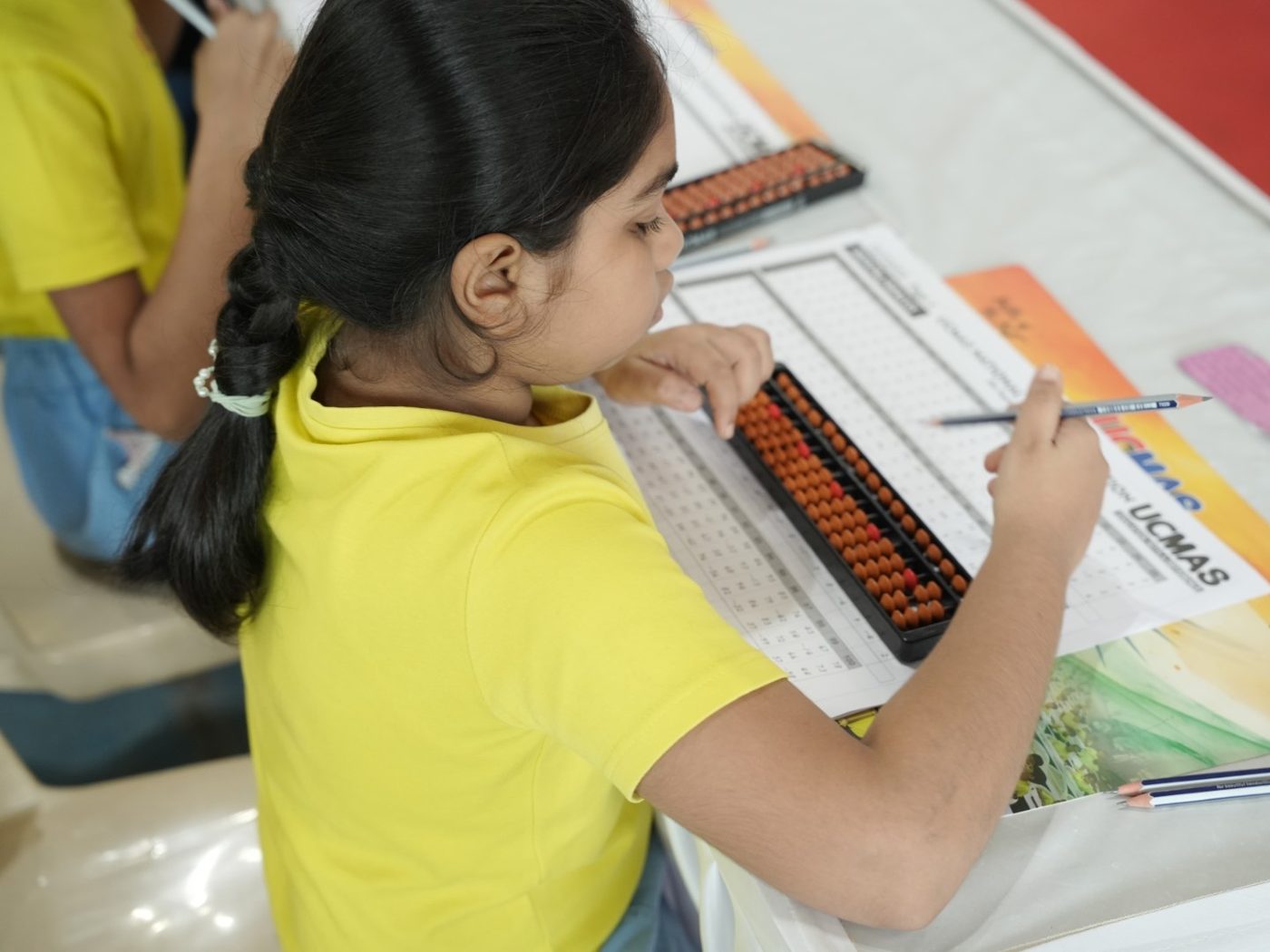
The tool at the centre of it is the soroban: a Japanese abacus with one bead above the reckoning bar worth five, and four below it worth one each. It is a physical, tactile way of representing number. A child who can move those beads correctly can eventually move them in their imagination — and that is where the real work happens.
What UCMAS is not: a maths tuition class. We do not teach the school syllabus, we do not set homework on it, and we do not promise better marks as a transaction. We train the underlying abilities — attention, working memory, visualisation — and better marks tend to follow because the child has become a stronger learner.
Methodology
Three phases, always in this order. Skipping any of them is what separates a well-taught abacus programme from a badly taught one.
The child learns bead positions and UCMAS’s own six-finger technique from day one. Six fingers moving on the beads activates all ten, and with them all five lobes of the brain — which is why technique is not optional here. Sloppy fingering caps how fast a child can ever go.
The physical tool is gradually withdrawn and the child starts calculating on an abacus they can only see in their mind. Listening exercises run alongside, so problems can be taken in by ear as well as by eye.
With consistent practice, the mental abacus becomes fast and reliable — children at the upper levels routinely handle long strings of multi-digit numbers quicker than an adult with a calculator.
The full curriculum
Children attend one two-hour class a week, usually at the weekend. Every level ends with a graded assessment and a certificate, so progress is something you can see rather than something you take on trust.
Basic and Elementary A: number sense, finger technique, and addition and subtraction on the physical abacus. Children in Class 1 or 2 begin one level earlier at Foundation Level, which adds four months and makes this module 16 months. This stage is deliberately unhurried — everything later depends on the habits formed here.
Elementary B and Intermediate A. Multiplication and division are introduced, and the child begins holding a mental image of the abacus alongside the real one. The first noticeable jump in speed usually happens here.
Intermediate B, Higher A and Higher B. The physical abacus is set aside. Children solve entirely in their head, and listening exercises are added so problems can be answered from the spoken word alone.
Advance Level, followed by optional Grand Level 1 and Grand Level 2 for children who want to compete seriously. Multi-digit mental calculation at competition speed.
There is one branch in the path, right at the beginning, and it is decided by school class rather than by a test.
Younger children start one level earlier, on a gentler on-ramp built for shorter attention spans — bigger beads, shorter drills, more play. It adds four months to the first module, taking it to 16 months in total, and it is time well spent: children who come through Foundation Level tend to have noticeably cleaner technique later on.
Older children skip Foundation Level and start directly at Basic, making the first module 12 months. They cover the same ground at a pace that suits them — nothing is left out, it is simply introduced faster.
What your child needs to start
If your child understands what addition and subtraction mean — that putting things together makes more and taking them away makes fewer — that is enough for us to begin. We build everything else from there.
We are not looking for children who are already strong at maths. In our experience it is often the opposite: the average student, or the one who has quietly decided they are “bad at maths”, is the one who changes most visibly. UCMAS develops ability rather than testing ability that is already there.
At the free demo class we place your child at the right starting level based on their age and where they are, not on a test they can pass or fail.
In the classroom
A single two-hour session, held at the weekend wherever possible so it sits outside the school week entirely. Light enough that it supports school rather than competing with it.
Every instructor is trained and certified by UCMAS before they take a class. The curriculum, the materials and the assessments are identical to every other UCMAS centre worldwide.
The one thing we ask of you at home. Short and consistent beats long and occasional — this is a motor and visual skill, and it behaves like one.
A formal assessment and certificate at the end of every level. You see exactly where your child is rather than relying on a teacher's impression.
Certificates issued from UCMAS headquarters in Malaysia — an internationally recognised record of your child's level that follows them.
Centre, state, national and international. Optional, but the children who compete tend to be the ones whose confidence shifts fastest.
Your child sits a real session, you watch how it is taught, and you decide afterwards. No fees, no commitment, nothing to cancel.